
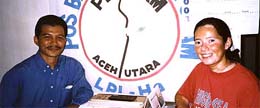
Nationality: Malaysian
Previous work: Master's Degree in Human Resource Development at Reading University, England.
PBI location: Indonesia Project, Jakarta team
PBI dates: 9 months in Jakarta, 1 month in Banda Aceh, 4 months in Lhokseumawe.
Training: Melbourne, Australia
How was the training?"
“I had a lot of fun, it was interesting. I observed a lot, and then became engaged. I liked the processes that we did: consensus decision making, team work, stress management. The training was in the Yarra valley, near a nature reserve. It was a beautiful place and the weather was good. It was hard for most of the trainees to imagine what it would be like in Indonesia, but I was already familiar with the area.â€?
Groups, individuals, and/or communities you worked with:
“I actually didn't do any accompaniment. In Jakarta, we didn't do accompaniment. In Aceh, when accompaniment was requested, my passport was being renewed, so I couldn't do it. When I was in Lhokseumawe it was a cease-fire period, and no-one was requesting accompaniment. I spent a lot of time with the clients, RATA and PB-HAM and RPUK, but not doing formal accompaniment. We signed a client agreement with LBH-APIK while I was there. I worked in Biren and Langsa in East Aceh.â€?
“I didn't feel bad about not doing accompaniment. I saw that there were many important things to be done, and I'm the kind of person who doesn't mind doing whatever needs to be done.â€?
Why did you join PBI?
“While I was doing my Master's I did my dissertation on post-conflict development, and I wanted to know what happens on the ground. I saw a small advert for PBI in Indonesia, and I was interested, since I knew the language, but I didn't have any human rights background.â€?
Why do you think protective accompaniment works?
“We've been in some very difficult circumstances, when the police searched the offices of one of our clients, and we accompanied them to the police headquarters. It was a very stressful time, but it was really helpful for the clients. When we're there the police aren't as intimidating and they don't threaten as much."
"There have been times when police tried to intimidate our clients and we behaved very calmly and professionally and they respect that. The dynamics change when they see that we can speak the language. We try not to aggravate the situation and it works for the clients, because they keep requesting our presence. On the whole, the people we accompany in Indonesia, they're still alive and safe. But we can't accompany everyone and unfortunately an organization like Koalisi has lost members to the conflict.�
What did you get out of being a volunteer?
“So many things happened, and I learned so much, how to use satellite phones, PGP, and so on. I'm not afraid of going into high-level meetings, having done so many of them now. Making decisions by consensus really helped me learn about myself. My Indonesian is much better! (I became the walking dictionary on the team). I made a lot of good friends there, it's a much livelier place than Malaysia.â€?
Is there one memorable or striking event which was important to you?
“We had been getting driving licences from the police in Banda Aceh with no problem. In Lhokseumawe, we had two new volunteers, and we wondered if the police would give us a license here rather than have to go all the way back to Banda Aceh which is a six-hour drive. So we went to the POA (the police department that deals with foreigners) in Lhoks and asked them. The man was asking us how much we paid in Banda Aceh. He took us to the traffic police and they were asking us all sorts of questions, and finally said, come back tomorrow and pay the fee and you're all set."
"The next day, because there were a lot of things happening, we thought it would be fine just to send the two volunteers back, thinking "they already know the people and the situation, all they have to do is pay". When they came back, they were very upset. The police had taken them to a small room and put them under pressure to pay and they had paid, but there was no receipt, and they were told to come back tomorrow for the licenses. The police said that the license was actually less money than what we paid in Lhoks, but that they would have to take a medical exam and a driving test to get it at that price. They told them that if they just paid this extra amount, they would have it done for them."
"So we thought, we can't let the police get away with this, so we all decided to go back the next day. We thought about all the possibilities, and worked out a strategy. We were all women, so we went there, all four of us, and put on this really sad face. We told them that these were new volunteers and they didn't understand, but we really needed a receipt. If we didn't get the receipts for our head office we would get in big trouble we said. It was amazing how they changed their tune. OK, that's fine, we can get you a receipt, no problem, The policeman actually returned the balance from his own pocket and we were stunned. We got the receipts and the licenses really quickly!�