
PBI Colombia is a non-denominational and independent non-governmental organization. PBI has engaged in international accompaniment and observation in Colombia since 1994.
The mission of PBI is to provide a protective space for the work of human rights defenders who suffer attacks as a result of their efforts in favour of human rights.
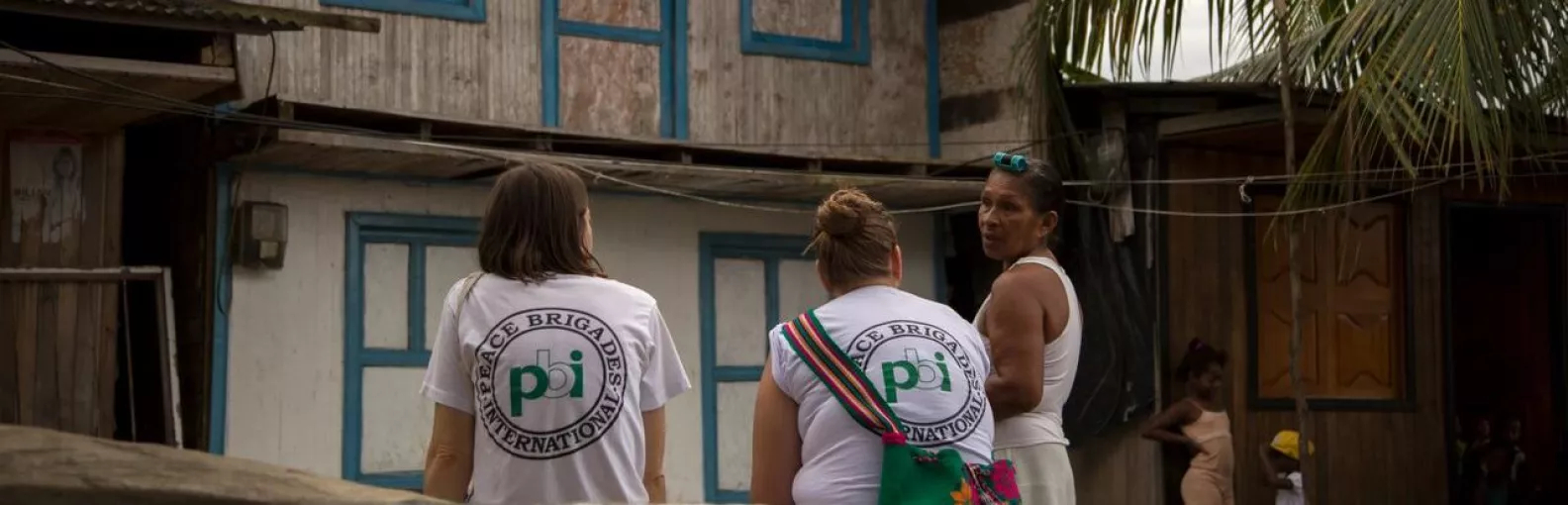
Volunteers work in the field accompanying threatened individuals, communities, and organisations in regions where their lives are at risk.
Our advocacy work plays a vital role in highlighting human rights violations in Colombia and the risk faced by human rights organisations. From our offices in Washington, Barcelona, and Bogotá we work with allies—embassies, UN agencies, human rights NGOs, government agencies, members of the legislatures of different countries, and religious organisations—to support the requests of accompanied people and communities and create international pressure in order to achieve full respect for human rights. Likewise, we meet with Colombian military and civilian institutions at the national and regional levels in order to convey our concerns regarding the situations of those we accompany.
We believe in a comprehensive approach to protection: in addition to security protocols and measures, emotional well-being plays a critical role. Therefore, an important part of our work is to strengthen individual and collective self-protection capabilities.
Through our publications we regularly report in English and Spanish on the risks faced by the people and communities that are in the midst of the armed conflict.
Our work observes a philosophy of nonviolence within the framework of international human rights standards and strict respect for Colombian law. We work only at the request of local organisations and maintain a strict policy of non-interference regarding Colombian internal affairs and the work of the accompanied individuals, organisations, and communities.
Areas of work
- The presence of international accompaniers in the field
- Advocacy at regional, national, and international levels
- Documentation of information and awareness-raising through regular publications
- Support for self-protection, security, and rebuilding the social fabric
Objectives
- Contribute to an improvement in the human rights situation in Colombia through the protection of organisations and individuals that defend human rights, as well as displaced and returned communities, thus supporting the establishment of lasting peace in the country.
- Bring the situation faced by human rights defenders in Colombia and the human rights situation in general to the attention of the Colombian government and authorities, as well as to the international community.
- Increase the visibility of the human rights situation and the work carried out by human rights organisations in Colombia.
- Strengthen the self-protection capacity of accompanied organisations by supporting their self-reflection processes, their development of protection strategies, and their work to rebuild the social fabric.
Who works for PBI Colombia?
- The accompaniment work is carried out by international volunteers that form part of the teams in Barrancabermeja, Apartadó, and Bogotá. Before their incorporation into the project they go through a training and selection process.
- PBI has a support office that carries out the specialized tasks of administration, coordination, psychosocial activities, advocacy, communications, training, context analysis and fund-raising, amongst others.
- In the European Union and North America, PBI carries out dialogue and public relations activities focusing mainly on the United States, Canada and Europe.
PBI Colombia’s structure
- Three field teams in Bogotá, Barrancabermeja (Santander), and Apartadó (Antioquia)
- Representatives in the USA and Europe